Talk to wedding photographers about what drains them during the season and money comes up quickly. Not the price itself, but the chasing: the balance that was meant to arrive before the Reception, the uncle who “will transfer after the function”, the album that is ready but cannot go out because nobody is sure what was paid.
A clear payment schedule, agreed at booking and written down, fixes most of this. Here is how to build one that suits Indian weddings.
Why a schedule beats “advance now, rest later”
“Advance now, rest later” leaves the most important part undefined. Later when? Before the wedding? After the album? A clear schedule:
- protects your cash flow across a season of back-to-back weddings,
- gives the family a plan they can budget around, and
- turns an awkward conversation (“sir, the balance…”) into a simple reminder of what was agreed.
The three moments money usually changes hands
Most wedding schedules come down to three points:
- Booking. An advance that holds the date. You are turning other enquiries away for it, so it should be meaningful.
- Around the wedding. One or more instalments before the first function or on a function day. Travel, crew and equipment costs land here, so this is where most of the fee usually sits.
- Delivery. A final balance when the edited gallery, films or album are handed over.
Larger packages often add a step, for example one instalment a month before the wedding and another on the wedding day.
Tie instalments to events, not just dates
A fixed date works until the family moves the Mehendi, and then every date in your schedule is wrong. Tying instalments to events keeps them right:
- On acceptance of the agreement, for the booking advance.
- A set number of days before the first function, for the pre-wedding instalment.
- On a function day, for example the wedding day.
- After delivery, when the gallery is delivered, the album is approved or the final files are released.
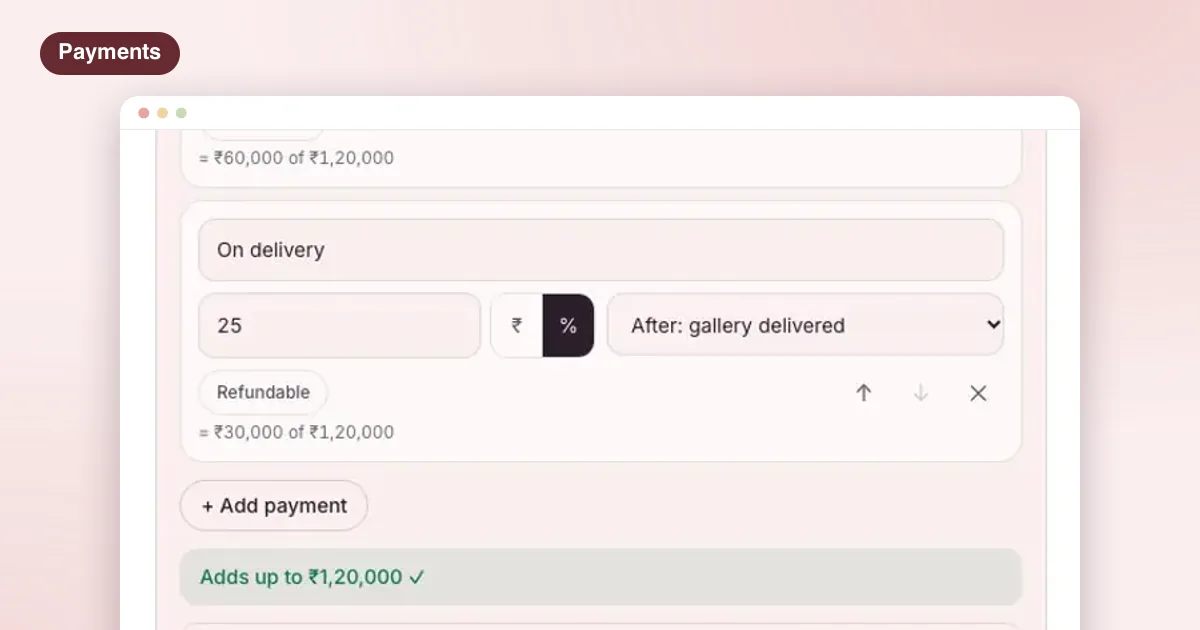
In LensPilot, each instalment in a payment plan can be due on acceptance, on a fixed date, a number of days before the first event, on an event day, or after a delivery step. When the shoot’s dates move, the due dates move with them. An amount can be a fixed rupee figure or a share of the fee, and the plan has to add up to the total fee before it can be saved.
An example schedule
Here is one way a photographer might structure a package. The numbers are an illustration, not a recommendation; set your own.
| Instalment | Due | Example amount |
|---|---|---|
| Booking advance | On accepting the agreement | ₹60,000 |
| Pre-wedding | 10 days before the Haldi | ₹90,000 |
| Wedding day | On the wedding day | ₹60,000 |
| Delivery | When the gallery is delivered | ₹30,000 |
| Total | ₹2,40,000 |
Two things make this work. Each line has a clear trigger, and the amounts add up to exactly the package fee, so nobody is confused about what is left.
Decide what each payment releases
The most useful question to settle at booking is: what does the couple get before the final payment?
A reasonable split for many studios:
- Before the final payment: viewing the gallery, watermarked proofs, album selection, notes on photos.
- After the final payment: full-resolution downloads and the printed album.
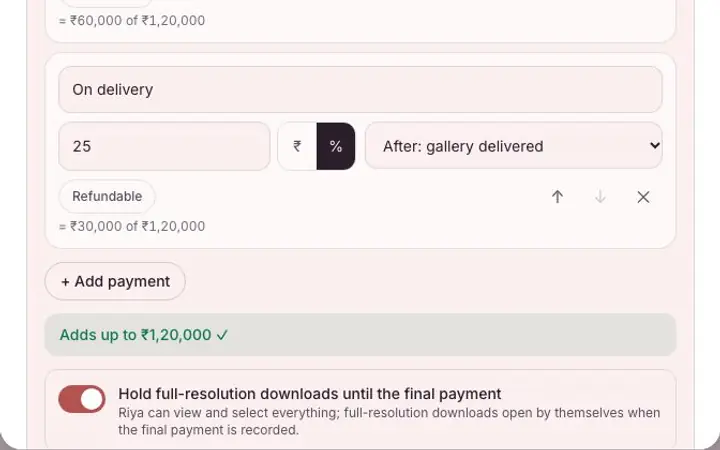
This keeps the couple moving (they can pick album photos while the balance is pending) without handing over everything before you are paid. In LensPilot, a payment plan can hold full-resolution downloads until the final instalment is recorded; when it is, the downloads open by themselves, and you can undo that if you need to. The couple sees a clear note that full-resolution photos unlock after the final payment, so nobody is surprised.
Write it into the agreement
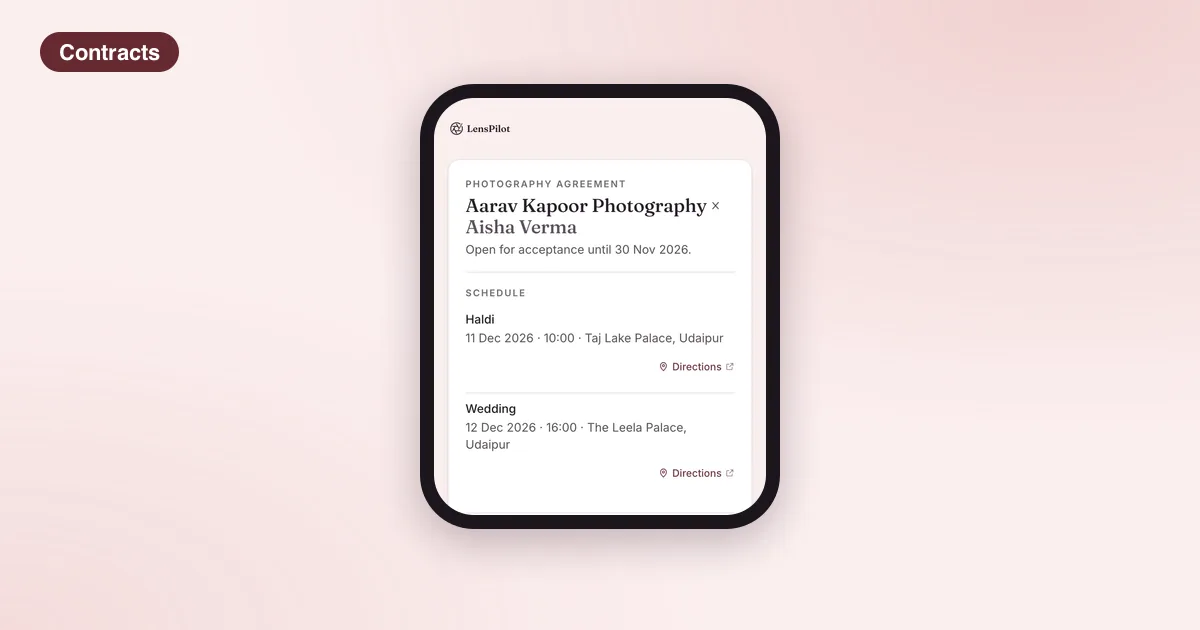
The payment schedule belongs inside the agreement the couple accepts, not in a separate message. That way the schedule, the deliverables and the cancellation terms are all on one page. We covered what else to include in our guide to wedding photography contracts in India.
Spell out:
- which instalments, if any, are non-refundable,
- what happens to paid instalments if the wedding is postponed,
- and how payments are acknowledged.
Recording payments as they come in
Families often pay in parts: a transfer from the father, cash from an uncle at the Sangeet, the rest after the Reception. If you only remember these, you will lose track by the third wedding of the week.
- Record every payment against the booking the day it arrives.
- Let it settle against the oldest instalment first, so an early or extra payment rolls into the next one.
- Send a short acknowledgement each time.
LensPilot works this way: you record a payment on the shoot, it settles the earliest unpaid instalment first, and each instalment shows as Paid, Part-paid, Due, Overdue or Upcoming. The Shoots list shows what is next due on each booking, and plans come with reminders.
Reminders that do not feel like chasing
A reminder is easier on everyone when it refers to something both sides agreed:
- Send it a day or two before the due date, not after.
- Mention the instalment by name (“the pre-wedding instalment, due ten days before the Haldi”).
- Keep it short and friendly; the agreement does the explaining.
When a payment is late
It will happen. A few calm steps:
- Check your own records first; make sure it really is unpaid.
- Send a polite reminder that names the instalment and the agreed due date.
- Keep working on what the schedule allows, for example the edit and album picks, while holding what it ties to payment, such as full-resolution downloads.
- If it drags on, talk on the phone rather than in long messages.
Bringing it together
A good payment schedule is agreed early, tied to events, written into the agreement, recorded as it happens, and connected to what the couple receives. LensPilot keeps all of that on the shoot: the agreement, the payment plan, each payment, and the gallery whose downloads can wait for the last instalment. You can see the studio tools on the home page, read how LensPilot works for photographers, or check what each plan includes.
Questions photographers ask
How much advance should a wedding photographer take?
Enough to make holding the date worthwhile, given that you will turn other enquiries away for it. The exact share is your business decision; what matters most is writing it down and saying whether it is refundable.
Should the final payment come before or after delivery?
Many photographers ask for most of the fee by the wedding day and a smaller balance on delivery. If you keep a balance for delivery, decide what is released before it is paid, for example viewing and album picks yes, full-resolution downloads no.
What if the wedding date moves?
Tie instalments to events where you can, such as ten days before the Haldi, rather than to fixed calendar dates. Then when the functions move, the due dates move with them.
Should I take payments in cash?
Whatever the method, record every payment against the booking and acknowledge it in writing. That one habit prevents most disputes about who paid what and when.