Ask any wedding photographer in Mumbai or Pune about their worst booking and the story usually has the same shape. Something was agreed on a call, half of it reached WhatsApp, and six months later the two sides remembered it differently. Written agreements are still rare in Indian wedding photography, and that is exactly why having one makes you stand out as a professional.
This guide covers what to put in writing, in plain language, and how to send it so couples actually read and accept it.
Why a written agreement helps both sides
An agreement is not about distrust. It does three practical things:
- It makes the booking real. The couple knows their date is held; you know the advance is coming.
- It settles questions before they become arguments. How many photographers, which functions, when the album arrives.
- It protects the relationship. When something changes, both of you look at the same page instead of scrolling through old chats.
The schedule: every function, with times and venues
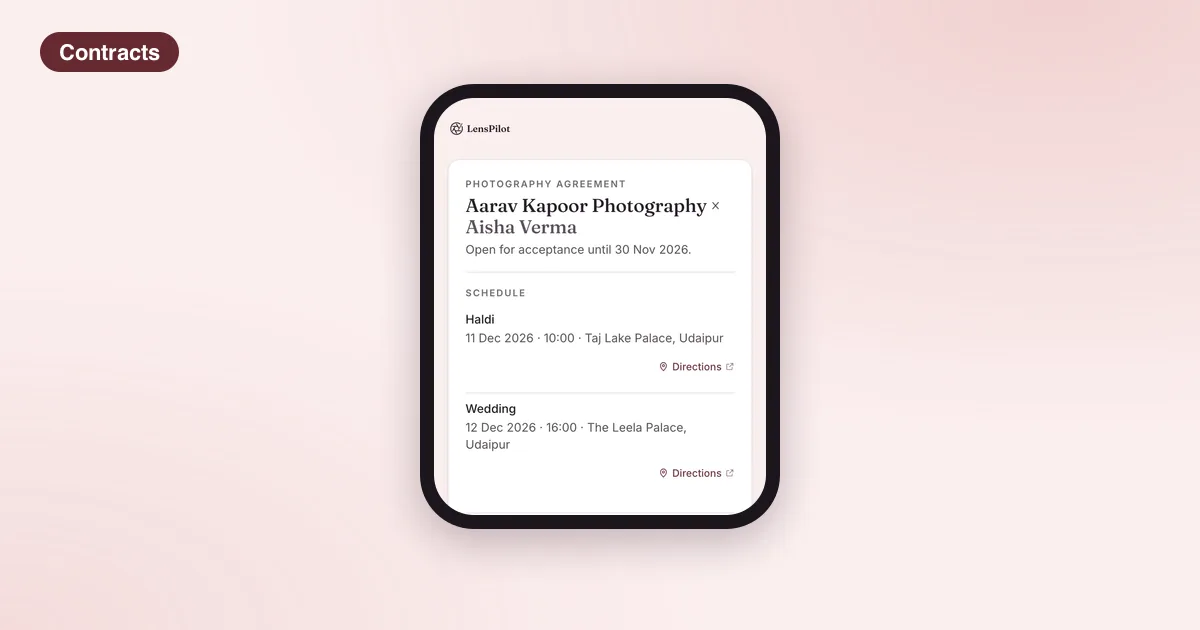
Indian weddings run across days and venues. List each function on its own line:
- The function (Haldi, Mehendi, Sangeet, wedding, Reception, pre-wedding shoot).
- The date, the start time, and roughly how long you will cover it.
- The venue, with a map link if possible.
Then add a line on what happens when a function runs over. Overtime is normal at Indian weddings, so agree in advance whether extra hours are charged and how.
The team: who is coming
Couples care about who shows up. Write down:
- The lead photographer, by name, and whether they attend every function.
- How many photographers and videographers attend each function, and their roles (candid, traditional, cinematography, drone).
- What happens if someone falls ill: a replacement of similar experience, informed in advance.
If you promise a named lead, keep that promise or say how a change will be handled.
Deliverables: what the couple actually receives
This is the clause most often left vague. Be concrete:
- Edited photos, and roughly how many, if you are comfortable committing to a range.
- Films: a highlight film, a full-length film, reels, with approximate lengths.
- Albums: number of albums, size, number of sheets or pages, paper type, and how many photos the couple can pick.
- How the couple receives everything: a private online gallery, a pen drive, prints.
- How long the online gallery stays available, and that the couple should keep their own copy.
Timelines: when each deliverable arrives
Give each deliverable its own timeline, counted from a clear point: “within six weeks of the reception”, “album draft within three weeks of receiving the couple’s picks”. Make the album depend on the couple’s picks, because a delayed selection otherwise looks like your delay.
Money: the total, the advance, and when the rest is due
Write down:
- The total fee for the package, and what is not included (travel, stay, extra hours, extra albums).
- The booking advance, and what it is for.
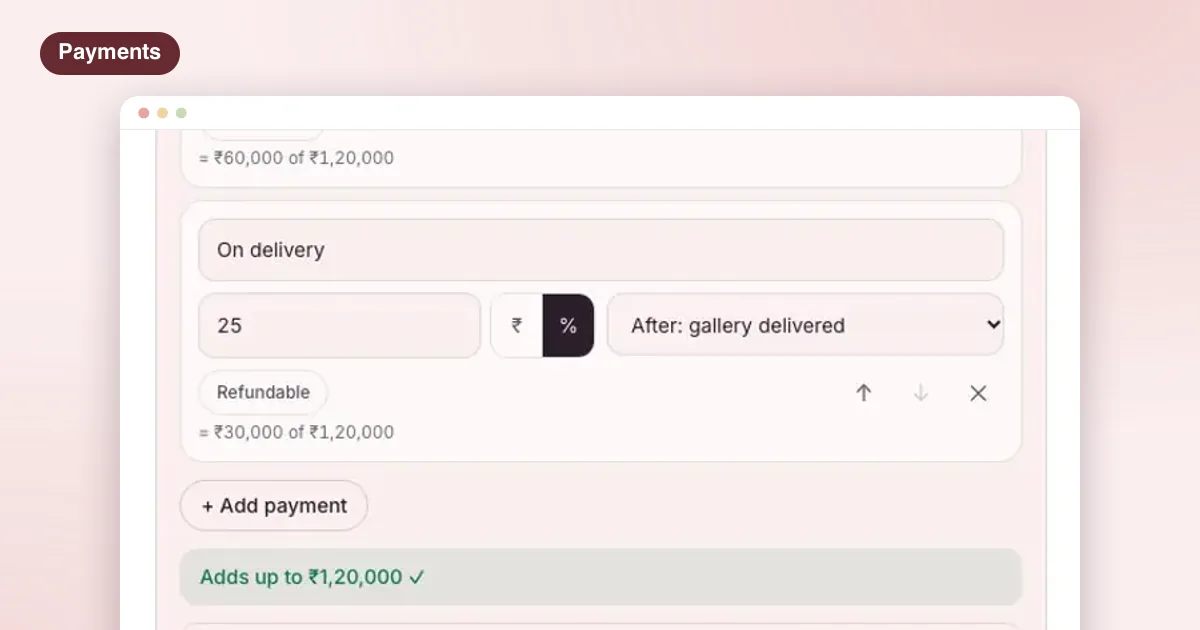
- Each further instalment and when it is due: on a date, before the first function, on the wedding day, or on delivery.
- How payments are made, and that you will acknowledge each one.
We cover payment schedules in more detail in our guide to advances and instalments, coming next week.
Cancellation and postponement
These are different events, and your agreement should treat them differently.
- Cancellation: what happens to the advance, and to any later instalments, if the couple cancels. Many photographers keep the advance because the date was held and other bookings were turned away.
- Postponement: whether the advance moves to the new date, what happens if you are already booked on it, and whether a new date has to fall within a certain time.
- If you cannot attend: how you will arrange a replacement, and what happens if you cannot.
- Events outside anyone’s control: what both sides will do if the wedding cannot happen for reasons nobody caused.
Usage: who can use the photos, and how
Couples often assume they own everything; photographers often assume they can post anything. Agree it:
- The couple can use the photos for personal use: sharing with family, printing, posting on their own social media.
- Whether you may use selected photos on your website and social media, and whether the couple can ask you not to.
- Whether the couple should credit your studio when they post.
Practical details people forget
- Meals and a short break for the team during long functions.
- Travel and stay for destination weddings, booked by whom.
- Access: venue permissions, drone permissions, where the team can stand during rituals.
- Raw files: whether they are included or not.
How to send it so it gets accepted
A ten-page PDF on email tends to sit unread. What works better:
- Send the agreement as a link the client opens on their phone.
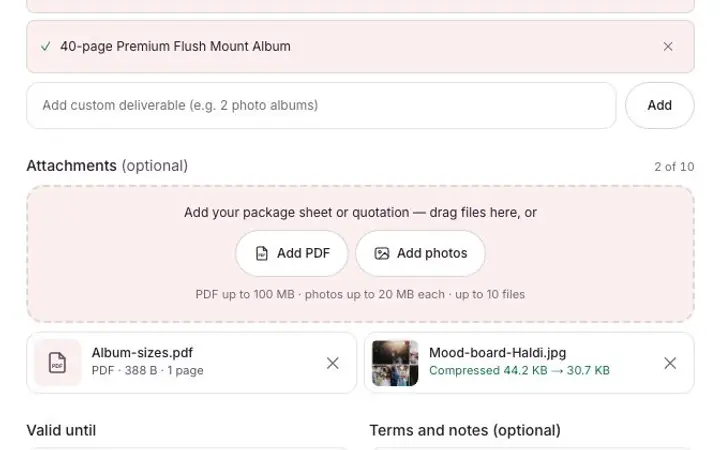
- Attach your package sheet or quotation so everything is in one place.
- Let the client accept online, and keep the record of when they did.
- Put the payment plan inside the same agreement, so the money and the schedule cannot drift apart.
In LensPilot, an agreement carries the schedule with venues, typed deliverables, your package PDF or photos as attachments, terms and notes, a date it stays open until, and the payment plan. The client reads it on their phone and accepts it online, and the shoot lands on your calendar. You can see what that looks like on the studio tools section or in how LensPilot works for photographers.
A short checklist
| Clause | Have you written down… |
|---|---|
| Schedule | Every function, date, time and venue? |
| Team | Who attends which function, in what role? |
| Deliverables | Photos, films, albums, and how they are delivered? |
| Timelines | When each deliverable arrives, and from when it is counted? |
| Money | Total, advance, instalments and due dates? |
| Changes | Cancellation, postponement, and if you cannot attend? |
| Usage | What the couple and you may each do with the photos? |
Once more: this is general guidance, not legal advice. Use it to prepare your questions, then have your agreement reviewed by a lawyer. To keep the agreement, payments and delivery in one place, see what each LensPilot plan includes, and our guide on how to deliver wedding photos to clients.
Questions photographers ask
Is a WhatsApp chat enough as a wedding photography agreement?
A chat shows what was discussed, but it is scattered, easy to dispute and rarely covers postponement, delivery or usage. A single written agreement the client accepts is far clearer for both sides. For anything legal, ask a lawyer.
Should the booking advance be refundable?
That is your business decision. Many photographers treat the advance as payment for holding the date, because they turn other enquiries away. Whatever you choose, write it down in plain words and say what happens if the wedding is postponed rather than cancelled.
Do I need the couple’s signature on paper?
Not necessarily. Many studios now send the agreement as a link and record the client’s acceptance online. Whether that is enough for your situation is a legal question, so take advice if you are unsure.
What if the wedding dates change after booking?
Have a postponement clause that says how a date change is handled: whether the advance moves to the new date, whether the new date depends on your availability, and what happens if you are already booked.